Friday

The Plan Ceibal English lesson plans

One of the ways the Plan Ceibal English programme is able to work is through the use of a specially-written lesson plan that allows the (generally non-English speaking) classroom teacher (CT) to follow what the remote teacher (RT, the English teacher) is teaching in Lesson A, and also that allows her to carry out the practice activities in the follow-up lessons B & C, when she is alone with the children.

As Jeremy Harmer mentioned after his visit and observation of a remote class:

The English lessons in Plan Ceibal look (as far as I can see) pretty much like most Young Learner English lessons. They include monsters and songs, basic grammatical patterns, the sort of vocabulary you'll find in most general English coursebooks, and scripts (with quite a lot of Spanish thrown in) to guide the distance teacher.
Objectives slide from the Week 1 lesson plan
The lesson plans are similar to the kind of lesson scripts you can find in some published course-books. They indicate (in some detail) what the teacher should do in each part of the lesson

There are actually two versions of each scripted lesson plan, one in English and one is Spanish. The Spanish version allows the classroom teacher to understand exactly what to expect to happen during the remote (class A) lesson and what they need to do to practise in the follow-up (classes B & C) lessons.
This seems to be working well. The survey of classroom teachers that was undertaken last year (650 out of a total of 985 CTs responded) showed that 65% of the CTs used the lesson plans almost always for classes B & C. 33% said they used them sometimes, and only 2-3% stated they never or almost never used them. It's also great to see that 98% of the CTs evaluated the digital materials of the programme positively. 

The lesson plans were (and are still) being written by a team of writers based in Argentina, led by Cristina Banfi and Silvia Rettaroli, and it is thanks to their hard work and those of their colleagues that they are working so well.

You can learn more about how these materials were developed by reading the paper 'ELT through videoconferencing in primary schools in Uruguay: first steps' by Dario Banegas (2013), who was the former project manager on the programme. In this paper, he talks about the importance of the weekly cycle of coordination (between the CT & RT), the lessons A, B & C and the ongoing evaluation and adjustments. The lesson plans have also been written to tie in with the Uruguayan primary curriculum. As Banegas states:-

The authors (Banfi and Rettaroli, 2012) drew on curricular content to teach English and established curricular and procedural bridges with the Uruguayan primary school curriculum. The course authors justified the adopted approach on the necessity to encourage language use related to learners' experience of the world and their formal education trajectories. This led to developing lessons which responded to learners' interests and context.

In a future blog post, I'll be looking at one of these lesson plans in detail.

Wednesday

Training for Ceibal English classroom teachers


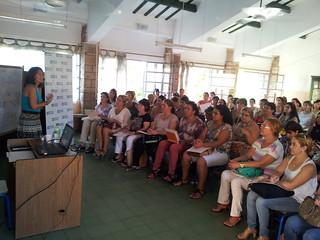
Claudia from Plan Ceibal addressing classroom teachers in Artigas
In preparation for the next expansion of the Plan Ceibal English project (we are going to be moving from teaching 1,000 classes a week to 2,000 from March/April 2014), we have started a series of orientation courses for classroom teachers.

The first of these took place in the north-west of Uruguay, in Rivera and Artigas (see picture left), near the border with Brasil.

One thing that's special about this project is that the classroom teachers who take part in the project are all volunteers. They are not forced to join and participate in the primary English programme. Fortunately, there have been no shortage of classroom teachers willing to join so far, and the project has benefited from word-of-mouth from participating classroom teachers and the overwhelming positive feedback from kids and parents.

The orientation course format used to be two days, but has been reduced to one day because it was felt that this is sufficient as an introduction for the teachers. The course has been supplemented with an excellent 12-hour online self-access course (specially developed for the project by the consultants-e) that classroom teachers do before the teaching starts.
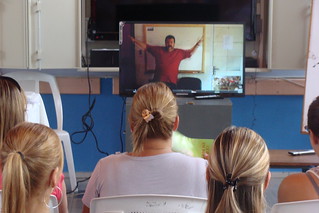
Gabriel from Eureka giving a remote lesson to classroom teachers

Because very few of the Uruguayan classroom teachers speak English, both the online course and the orientation course are delivered in Spanish. The programme of the orientation course starts with an introduction to the project and then the 100 or so classroom teachers are split into two and receive input sessions on Learning a Second Language (see presentation below), the Role of the Classroom Teacher and Remote Teacher, LearnEnglish Pathways (the online self-access English course written by the British Council that all of the classroom teachers are obliged to follow).


There is a demonstration lesson held via video conference so the teachers get a clear idea of their role during a remote lesson (what we call Lesson A) and this is followed up by an example of the practice lessons (Lessons B & C) that the classroom teacher does on their own. They are able to do this because of scripted lesson plans that detail the activities they need to do in class. They are supported in this task by the remote teacher during a weekly coordination session, that we recommend takes place in real time (via Skype or using the VC equipment). The Lesson Plans of the project, specially written by a team of writers in Argentina are also presented (see presentation below)


The orientation courses continue every week in different parts of Uruguay (Montevideo, Rivera, Artigas, Salto, Paysandu) throughout February and March. When classes start again in March/April, primary schools in all departments of Uruguay will be covered by the project. The expansion planned for 2015 is expected to be the final expansion, and the plan is to reach all primary schools in the country (give or take some rural schools where the fibre-optic cable does not reach) - an estimated 4,500 classes per week.

Read more blog posts about Plan Ceibal English here.


Thursday

Plagiarists and cheats

Ann Loseva, one of the BritishCouncil's new TeachingEnglish associates, has written a very touching post called I HATED THAT FELLOW (C) C.G. JUNG on her personal blog that is a reflection on cheating/plagiarism undertaken by students and the reaction of teachers have to this.

It made me think of the times that I called out students for cheating or plagiarism and I thought I'd share something related here on my blog.

http://en.wikipedia.org/wiki/File:Cheating.JPG
In denial and aggressive

When I worked for a private university in Barcelona, I used to have zero tolerance for plagiarism and cheating. There was one short specialised course in particular that I taught for which I required a specific piece of writing that some students found difficult to do and which prompted some to copy and paste from articles they found on the Internet. I warned the students at the beginning of the course that if I considered plagiarism to be the ultimate sin on this course, and would give them '0' not only for the work submitted, but for all of the course if I caught them doing it. I told them that if it were up to me, they'd be thrown out of the university. It's a particular bugbear of mine because I hate laziness, especially when people try to skive hard work and get something for nothing.

Despite the warning, there were those who submitted obviously copied texts. They are usually easy to spot as it's highly improbable (impossible, in fact) for upper-intermediate students to submit writing in the style and manner of a professional journalist. I don't even remember any of them trying to be clever about it and changing some of the text to include mistakes, although there might have been some who did this and who got away with it. The worst cases were those who had copied and pasted badly, including parts of the original web-page (buttons, other odd formatting) in their printed texts.

I'd usually confront them at the end of the course, when they'd meet with us to discuss their marks and they would have the chance to argue their case if they thought they'd been treated unjustly. Most of the guilty wouldn't turn up to contest my decision, preferring to shirk away from confronting me. Some did and then stared down at the ground and mumbled apologies when I presented the evidence of their misdeeds. 

I remember one, though, who confronted me and despite acknowledging he had blatantly copied and pasted his work, tried to persuade me to change his mark because otherwise he would fail English. I refused and he became quite aggressive in his stance, even trying to tell me that his father was very well-connected with the university and that he would speak to the director and make things difficult for me. I called his bluff and told him that my decision had been made and that he should go ahead and do what he thought was the right thing. He stormed out of the school. I don't know whether he tried to get his father involved or not, but fortunately I never heard from him again.

Propogating the plagiarism /cheating culture

The fact that many of the students at that university did blatantly cheat in exams or plagiarise their coursework in other subjects didn't really surprise me. You could see why they thought it was OK if you looked at what many of the teachers and administration allowed to happen in their institution. Here are a few examples of the same kind of culture that was condoned or promoted at the place (and probably still is):
  • Students photocopying books. Despite most of the students being very well-off, in many subjects, one student would buy a book and lend it to others who would photocopy it. They would often do this using the photocopying facilities in the school, and for some courses, a photocopied book would be available to buy there.
  • Academic dishonesty. Some of the tutors on the university courses were not properly qualified. Two of them I know were put on official student lists during the time I was there so they could be granted degrees from the university, despite not ever going to class or studying any of the subjects. These tutors were experienced, but did not have sufficient qualifications. Despite this, they were teaching on undergraduate degree courses, and one of them was even tutor of the university's Master's programme. 
Hardly surprising I suppose that there was a cheating/plagiarism culture amongst the students.


Monday

Tracking conferences and connecting with other speakers

From time to time, I read posts on Facebook from people who wish it were easier to keep track of the many ELT conferences that take place annually, and it's true - I expect it's on the wishlist of every ELT conference speaker and those who attend conferences, but rather than it stay simply a wish, what would be the best way to make it happen?

The major teacher organisations are probably in a good place to make it work, and it is true that IATEFL publish a listing of conferences in their Voices newsletter, but this is only available to members and so not accessible publicly online. TESOL publish a calendar of events, but this only seems to include those events related to the organisation or affiliates (the annual IATEFL conference is not included on the list, for example), so unless someone well-placed in either of these organisations takes it on, we'll have to look elsewhere.

The British Council is another organisation very well placed to manage such a list, especially given the support the organisation gives to ELT conferences around the world, on a local, national and international level. Perhaps the best place to host this list of conferences would be the excellent Teaching English website, and indeed there is a home for this list there, but "the directory of upcoming educational events and conferences around the world" currently only lists past conferences and so is hopelessly out-of-date.

A quick search on the Web leads to other listings, such as the Conference Alerts website, with a listing of language conferences worldwide and the ELT Calendar, which lists only events in Japan.

Individuals have also tried to compile lists, such as the 2013/14 conference calendar for Turkey published by Tony Gurr.

Perhaps the best way of promoting such a directory though, would be to adopt what other professionals in other sectors are doing, which is using the website Eventbrite to publish details of an event and to use the associated website Lanyrd to give details of speakers/attendees and help them connect to each other. Eventbrite is now being used a lot by some ELT associations to publicise events - I first realised its effectiveness for this during this TESOL Spain event in Barcelona - it seemed to make it easier for the organisation to manage the event and easier for the participants too.

As for Lanyrd, I came across it again last Sunday (although I'd actually signed up for an account in 2012) and discovered that BRAZ-TESOL have been flirting with it for a while now, although it doesn't seem they are using it for all their events and haven't used it recently. As a conference speaker it looks like a very interesting way of advertising what you have to offer and a great way of connecting with people at events, but this would only work if other people actually use the site (as is the case with all communities and social networks). What do you say, shall we give it a go, or do you know of a better way to keep track of ELT events and the people who attend them?

Revision to post:

I should have remembered this (Thanks to Julie Raikou!), but Tyson Seburn has been keeping a crowd-sourced ELT events calendar which is probably the best source that is available at the moment. There's a form where people can submit an event at the bottom of the page, so I encourage you to do so whenever you know of one that is happening.

TESOL EVO 2014

Looking forward to TESOL's annual Electronic Village Online this year, which has just opened its call for participation.

I am giving a session and helping out with the moderating of Teaching English to Young Learners and Teenagers. Their blog is here and communication between members is taking place on the TEYLT2014 Yahoo Group.


Crafting the ePerfect eTextbook promises to be a very interesting session, so I've signed up for that too. This group is connecting through a Google+ community and is using Listly to share resources and using the Twitter hashtag #EbookEVO. The session syllabus is here and the The list of moderators is extensive and includes many well-known teachers, teacher trainers and material writers. It's being sponsored by the IATEFL TD SIG and IATEFL MaW SIG and aims to help participants "outline, design and complete 1 chapter of an e-textbook that meets their learners' needs ". The moderators and other participants on the session will provide feedback during the five weeks.

The final EVO session I've signed up for is ELT podcasting. I used to do a lot of podcasting, but haven't done so much in recent years. I've decided I'd like to start a new podcast this year, and so through this group, I'm interested in connecting with other podcasters and seeing what's changed and what people are doing. This group has three blogs: a session blog, an activity blog and a readings blog. They are communicating through a Yahoo group and through Twitter (#podcasting2014 is the hashtag).

Are you participating in EVO2014? If so, what sessions have you signed up for?


Friday

Awards, prize, polls and virtual pats on the back

2013 was the tenth year of the annual Edublog awards and when I began this post (in December) voting had just opened for nominees. I remember when the awards started, back in the day when it was just about conceivable to regularly read all of the major edublogs, and I also remember being thrilled when my podcasting blog (now defunct) was short-listed for an Edublog award in 2005. Then, the awards were generally embraced by the educational blogging community as a way of recognising and highlighting the ground-breaking work that educational bloggers were doing. Blogging wasn't the mature form it seems to be now, and it was both exciting and necessary for the edublogging community to have something that brought us together and which drew attention to what individual edubloggers were doing.


This year, as in the past, the awards have attracted both valid criticism, but also cynicism and cheap jokes from a growing number of people. This is a wave that has been growing for some time. Back in 2008, Dave Cormier criticised the awards for the following reasons:
  • Fostering competition rather than collaboration and co-operation
  • They are promoted by people with vested interests
  • It's very easy to rig them
The main criticism of this type of award is that it is little more than a popularity contest, but I suppose this is true of many awards. It is probably true to say that there is no awards system which is not flawed. It would be fairer to judge it another way, maybe. A group of experts selected by the awards, perhaps using the Delphi Method? This is the way the winners of the British Council ELTon awards are decided and the identities of the judges are kept secret. But, then who selects the judges? Generally, past winners of the awards, along with ELT luminaries and British Council staff are are invited to be the judges (as far as I can tell).

However winners are decided, it is certainly a thrill to be nominated, and even more so to win an award. I remember being very excited when Digital Play was nominated for an ELTon in 2011, and it was totally unexpected honour when the book won - I really did not expect it (which was why I was in the Gent's loo when we were called up to accept the award and to make a speech). My second book, Language Learning with Technology (CUP, 2013) has just been awarded the English Speaking Union's HRH Duke of Edinburgh Award, and I have rearranged my travel plans to make sure I can attend the ceremony on 25th February. One of the reasons it is important is it makes you feel it all worth the effort. Methodology books never sell enough copies to make you feel the enormous amount of time and effort that you have invested in the writing and editing was worthwhile, so you have to find other reasons to justify the time you spent on them. Winning an award is recognition that you spent your time well, as is reading a review of the book and hearing from colleagues and friends that they are using the ideas in the book.

Writing a blog and sharing your thoughts, ideas and reflective practice can also be hard if nobody drops by to comment - if you feel there's an audience out there reading and appreciating what you write, however, then it feels that all is worthwhile. If nothing else, initiatives such as the Edublog awards encourage readers to blogs and draw people's attention to blogs they may not have otherwise come across - I always make sure I check out the winning and short-listed blogs and so I'm firmly on the side of these virtual pats on the back.

Monday

How well are the people of the world speaking English?

I recently attended the launch of the EF English Proficiency Index 2013 (full PDF report here) in Montevideo (left), where participants were told that Uruguay is still in the 'low proficiency' bracket and has dropped in points (from 53.42 to 51.49) since the EPI was last published in 2012. It was not included in the first EF EPI published in 2011.

The 2013 edition of the EFP ranks 60 countries and territories by adult English proficiency, was produced with data collected from 750,000 test-takers and is a report that attempts to rank average level of English skills amongst adults (Wikipedia).  Most of the data is collected by EF from the free placement test taken by people on their website.  As such, the report has been criticised for a lack of representative sampling in each country. As such, this makes the EPI an online survey rather than a statistically valid evaluation (Wikipedia). When we asked about the data at the launch in Montevideo, EF were open about this and details about data collection is also clearly mentioned in the report on page 42.

Despite the above, it has been very interesting to see just how much attention is being paid to the results. In Uruguay, the 'decline in English' in the country stated in the report made the major newspapers and the same seems to be true in many other places - it's been featured in the New York Times, the World Bulletin, the Bangkok Post, the Swedish Wire, and the Wall Street Journal, and I'm sure many other periodicals, newspapers and websites. It's all fabulous marketing for EF, who have found a way of delivering information that the world wants to know, and which no other organisation is trying to provide. 

Moving to Substack

  I've decided to start blogging on Substack rather than here.  Come and join me over there .