Showing posts with label ceibal. Show all posts
Showing posts with label ceibal. Show all posts
Saturday


Wednesday
Training for Ceibal English classroom teachers
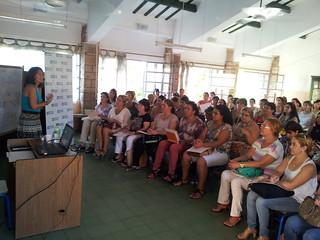 |
| Claudia from Plan Ceibal addressing classroom teachers in Artigas |
The first of these took place in the north-west of Uruguay, in Rivera and Artigas (see picture left), near the border with Brasil.
One thing that's special about this project is that the classroom teachers who take part in the project are all volunteers. They are not forced to join and participate in the primary English programme. Fortunately, there have been no shortage of classroom teachers willing to join so far, and the project has benefited from word-of-mouth from participating classroom teachers and the overwhelming positive feedback from kids and parents.
The orientation course format used to be two days, but has been reduced to one day because it was felt that this is sufficient as an introduction for the teachers. The course has been supplemented with an excellent 12-hour online self-access course (specially developed for the project by the consultants-e) that classroom teachers do before the teaching starts.
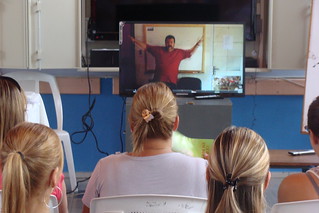 |
| Gabriel from Eureka giving a remote lesson to classroom teachers |
Because very few of the Uruguayan classroom teachers speak English, both the online course and the orientation course are delivered in Spanish. The programme of the orientation course starts with an introduction to the project and then the 100 or so classroom teachers are split into two and receive input sessions on Learning a Second Language (see presentation below), the Role of the Classroom Teacher and Remote Teacher, LearnEnglish Pathways (the online self-access English course written by the British Council that all of the classroom teachers are obliged to follow).
There is a demonstration lesson held via video conference so the teachers get a clear idea of their role during a remote lesson (what we call Lesson A) and this is followed up by an example of the practice lessons (Lessons B & C) that the classroom teacher does on their own. They are able to do this because of scripted lesson plans that detail the activities they need to do in class. They are supported in this task by the remote teacher during a weekly coordination session, that we recommend takes place in real time (via Skype or using the VC equipment). The Lesson Plans of the project, specially written by a team of writers in Argentina are also presented (see presentation below)
The orientation courses continue every week in different parts of Uruguay (Montevideo, Rivera, Artigas, Salto, Paysandu) throughout February and March. When classes start again in March/April, primary schools in all departments of Uruguay will be covered by the project. The expansion planned for 2015 is expected to be the final expansion, and the plan is to reach all primary schools in the country (give or take some rural schools where the fibre-optic cable does not reach) - an estimated 4,500 classes per week.
Read more blog posts about Plan Ceibal English here.
Friday
Ceibal English blog posts

The Ceibal English (Ceibal en Inglés) is a project involving language teaching via video-conferencing in Primary schools throughout Uruguay.
The British Council Uruguay is managing the Ceibal English (Ceibal en Inglés) project for Plan Ceibal and I was working as the project manager. (update: I am now Country Director for the British Council in Uruguay)
As it develops, expanding from 500 to 1,000 classes a week in 2013, and doubling again to 2,000 classes a week in March/April 2014, I am recording and relfecting on different aspects of the project.
This page lists all of the blog posts I have written about the programme.
- Remote Teaching for Success
- Ceibal English - Invitation to feedback session for forthcoming chapter
- Remote Teaching, distance learning, team teaching or blended learning? (updated)
- Interviews with Remote Teachers on Ceibal English project
- Results of the Project Impact Test 201
- Remote teaching, distance learning, team teaching or blended learning?
- The Ceibal English lesson plans
- Training for Ceibal English classroom teachers
- Use of L1 in Ceibal English remote teaching
- There's video-conferencing...and then there's video-conferencing
- Distance learning? Remote learning?
- 3 Months of Ceibal English
- Plan Ceibal: Dario Luis Banegas
- Paul Woods: One laptop per child
- The Whys and Wherefores of OLPC in Uruguay
Thursday
New British Council podcast - Ceibal English interview
Earlier this month I was thrilled when asked to be interviewed by Rob Lewis about the Ceibal English project for the new British Council English Agenda podcast for teachers. It was an honour to be part of the first episode and a lot of fun to do. The result can be listened to here:
http://englishagenda.britishcouncil.org/content/englishagenda-podcast-15th-october-2013
 1. You’ve been in Uruguay for a few months now – can you tell us about the project you’re managing?
Ceibal en Ingles (Ceibal English) is a project the British Council won after a tender was issued by Plan Ceibal for English language teaching via video-conferencing in Primary schools in Uruguay. You will have heard of Plan Ceibal as the organisation that has succeeded in the OLPC initiative.
It started five years ago, and now each state school child in the country has received a laptop. With English, however, there aren’t enough qualified and experienced English teachers to be able to offer primary children classes, and although in the long-run the solution will be to increase the English level of the existing primary school teachers (something which we are also involved in as part of the project), the short to medium term solution is to offer the children English classes via telepresence solution using remote teachers from Montevideo, Argentina, Colombia, Mexico and the Philippines to teach the classes in tandem with the children’s regular classroom teachers.
2. A lot of people probably associate this tool (VC) with business meetings. When you talk about video-conferencing in the classroom, what do you actually mean?
Yes, nowadays, people either associate VC with low quality, low bandwidth tools such as Skype which work more or less well on most computers and with an internet connection…or with the higher quality video conference suite equipment, that as you mention, is most associated with international business. The latter, using fibre optic lines and high quality equipment is what is used in this project. The reasons for this are many. One factor is reliability. With a classroom teacher and 25+ kids waiting for a weekly lesson, we need to know that when a remote teacher connects it is going to work, and with this equipment you can 95% (or more) guarantee it is going to work. You wouldn’t be able to offer a similar guarantee with something like Skype. Another factor is quality of image. With this equipment the remote teacher (or RT as we call them) can see details of the children (and can also zoom into specific kids, etc) and so it becomes easier for them to learn their names and recognise them. The high quality also means that on the other end of the line, in the classroom the image is so sharp on the big screen that it is as close as possible to actually having the RT in the classroom, which makes a big difference for the kids. It is hard to appreciate how important this is without actually going and observing a class in progress.
3. I’m sure there have been ups and downs. What’s worked well so far?
Yes, of course. After a successful pilot that showed it was possible and which also proved the children were learning, we are now teaching almost 1000 classes a week (reaching around 25,000 children). This will double to 2,000 classes in 2014 and more than double again in 2015 to 4,500 groups (around 120,000 students). The best part of the project for me has been the response. Classroom teachers volunteer to join the programme and there has so far been no shortage of teachers volunteering. This is despite the extra effort and time these teachers need to have in order for the project to work well. The classroom teachers (or CTs as we call them) have to spend extra time coordinating with their RTs and are also learning English themselves, which enables them to understand the classes and also to do the follow-up practice lessons that have been built into the programme so that the kids have enough English to get them from a CEF level of A0 to one approaching A2 (we hope) after three years of classes.The reaction of the kids has also been heart-warming – English classes, once the privilege of a few who could afford to pay for private classes are now being given to primary children all over the country, many of whom live in difficult circumstances. It is a real game-changer as far as helping to level the playing field and provide equal educational opportunities to all.
4. And anything that’s not worked so well?
We are learning all of the time and changing things to help improve the teaching and learning. One thing we have discovered is the importance of coordination between the CT (local primary classroom teacher) and the RT (remote teacher). In order to avoid transmission teaching (i.e. the “teacher on the telly” syndrome) the CT & RT need to work closely together, to talk about out what is going to happen in the remote class and follow up classes. Originally we were hoping that all teachers would be able to do this synchronously (e.g. using Skype) but because of time differences, busy schedules, and other reasons, most of this coordination is by necessity being done using email. For this to work well, there needs to be a flow of 4-5 emails between the two teachers. The majority of the problems we have experienced have been due to a lack of rapport between the CT & RT and because both have not been able to do the necessary lesson coordination.
5. I can imagine it changes the dynamic somewhat having a CT and a RT present in classes… does it have a significant impact on the pedagogy too?
Yes, it does, and I have been spending a lot of time recently observing classes and taking note of good and not so good practice. Some of what is important is the same with regular YL classes. For instance, the teachers need to establish routines, pace the classes and use a variety of activities, including games and songs. The kids can’t also just be sitting down watching the teacher on TV in the same way that you wouldn’t want a class of children sitting down through a regular YL class. There are some interesting avenues that we still need to explore and which some teachers are already exploring. For instance, and this came up in a discussion during a recent visit by Jeremy Harmer, the fact there is a TV lends itself to adding an aspect of performance to the lessons. The kids can write, rehearse and act out dialogues and other theatrical routines in front of the TV, for example. We have also been discussing the role and amount of L1, which varies enormously depending on the teachers involved. We are recording all of this and developing guidelines which will end up becoming recommendations for any educators involved in this unique type of language teaching be they on this project or any other one that may appear in the future.
6. It must have an effect on the learning opportunities too? E.g. if a learner wants to experiment with language or has a question, how can the RT be there ‘on the spot’ to support? Or is it possible for the RT to give feedback? How have the RTs taken to it?
Feedback is something each RT struggles with. I have seen RTs give on-the-spot pronunciation feedback and error correction during classes, so it is possible. More difficult is giving feedback on student writing. We have set up a system of virtual classes using a Learning Management System (LMS) that requires the children to upload their written work using their OLPC laptops and which means the RT can then correct. Other RTs have used blogs or wikis as a way of sharing student work and dealing with correcting writing. We are still working on this as we are not entirely happy with the solutions we have come up with so far.
7. How have the CTs taken to it? Are they taking part in any training? And what about the students?
Yes, in general, as the CTs are volunteers, they have shown an incredible amount of passion and commitment to the project and most of them have also started to learn English themselves. There are some primary teachers that have said they are not interested, but I’m happy to say they seem to be in a minority at least at the moment. Our challenge will come as we expand and incorporate what we hope will be all of the primary schools into the programme. The students, as I mentioned earlier have very much taken to it. There has been pressure from students and parents on teachers and schools to sign up and join in the project, which has been nice to see.
Training has been built into the project very much as an integral part. Each of the CTs need to attend a 2 day orientation course in Montevideo before they can join the programme. We are also developing a 12 hour supplementary course for CTs that will act as an online reference guide for them after the OC. RTs have a 15 hour self-access online course they need to do before teaching and we recommend that the RTs observe at least two classes before teaching one themselves. Apart from that, the RTs are connected via the LMS and can share their concerns and ideas there via a forum. We also have plans to get some of them together in December in Montevideo for a training day to share good practice. We will record this and make the discussions available to the RTs who cannot attend.
8. What next? Long term programme? Research must be part of it? Lots of countries must be looking on with interest!
We are developing a model of teaching that has a lot to offer other countries and organisations outside of Uruguay. Research has been built into the project, with regular surveys of RTs and CTs and a lot of data collection being undertaken internally. We have also just finished testing the children and will be repeating this test at the end of the year in order to determine what the impact of the English classes is having. We are giving the test to classes of children not involved in the programme too, so we have a control groups. We have also been approached by different educational bodies in different countries who are looking at what we are doing with a lot of interest and wondering if it could be something they too could implement.
Friday
Distance learning? Remote learning?

At Ceibal, we talked about this label and how the term remote teacher had been adopted instead and that we didn't think distance teacher was the appropriate term. From the time of piloting the term remote teacher has been used throughout the project internally. In the paper written by Dario Luis Banegas (2013), he briefly explains the teaching situation of Ceibal English in this way:
'Plan Ceibal seeks to demonstrate that lessons delivered by remote teachers (RTs) via videocon-ferencing with support from classroom teachers (CTs) with little command of English can facilitate successful learning outcomes in learners, including effectiveinteraction with the RT, CT and between learners.'
Why does the project prefer remote teacher (RT)? Well, Wikipedia describes distance learning as 'a mode of delivering education and instruction...to students who are not physically present in a traditional setting such as a classroom' and it 'provides access to learning when the source of information and the learners are separated by time and distance, or both.'
In the Ceibal English project, the students are physically present in a classroom. Additionally, although the RT is separated by distance from the students, they are with their regular teacher (the classroom teacher, or CT), whose role is crucial if successful learning to take place (this is not a transmission teaching model unlike the plasma teaching that took place in Ethiopia - but I'll save that for another blog post at another time).
What is clear is that the Ceibal English system is all about team teaching, with the RT being the qualified and experienced English language teacher and the CT being the teacher who best knows the learners and who is responsible for classroom management and the language practice activities during the week.
To be honest, the term remote teacher is not ideal either. If you search for remote teaching in Google, then you'll find examples of regular teaching being done in remote communities, such as this one from Western Australia. However, the kind of teaching being done in the Ceibal English project is distinct from the teaching being done by what most educators assume to be distance education, so it is worth using a different term to distinguish it.
Thursday
3 months of Ceibal English

Shortly after I arrived, the project expanded from 500 English classes a week to just under 1000, with classes being taught in multiple locations across the country by remote teachers from various institutes in Montevideo, the British Council in Colombia and Mexico, AACI and other institutes in Argentina, and SME in the Philippines. I'm happy to say this expansion phase was successful thanks to the efforts of many dedicated professionals and it definitely feels exciting to be part of what is a unique countrywide complex project involving the teaching of English and a combination of learning technologies.
Since the expansion phase in July, I've been able to observe teachers at work and my idea is to now blog about different aspects of the project here. It is a complex and dynamic project that is changing as it is being rolled out. There are parts of the project that tend to indicate a new teaching methodology is required, and Jeremy Harmer reflected on this in a recent blog post after visiting a school and observing a class. This post and the comments posted by a variety of people both involved and not involved in the project make very interesting reading. It's partly due to the comments posted there that I've decided to reflect on different aspects of the project here.
Find out more about the project here:
- Perspective from the point-of-view of a remote teacher - British Council blog post
- Report of Ceibal English session by Paul Woods at IATEFL
- Report of Ceibal English session by Nicolas Dantaz-Rico at IATEFL
- ELGazette Latin America supplement with articles about the project (needs registration and then access to back issue Jul 2013)
- El Observador newspaper article (in Spanish) about the pilot results and expansion
- Mariana Montaldo's presentation for the Virtual Round Table
- Video documentary giving a good overview of Plan Ceibal in general
Subscribe to:
Posts (Atom)
Moving to Substack
I've decided to start blogging on Substack rather than here. Come and join me over there .

-
The Interactive Whiteboard ( IWB ) is a technology that promises to truly transform the classroom and yet is seen as a threat or a waste of...
-
 This is part 2 - part 1 can be read here Sugata Mitra 's plenary on the last day of the IATEFL conference was entitled The Future of L...
 -
 On his substack, Jason Gulya outlines a paradox: "Learning with AI tools suffers from a paradox. To use AI as an effective tool, learn...