During the IATEFL conference in Harrogate, I noticed that Russell Mayne's presentation was mentioned a lot on various social media channels. Russell, who is behind the Evidence-based EFL Twitter handle and blog of the same name has now also written about the buzz his talk created in a lively blog post. As you will understand, the subject of his talk is disruptive (you could describe it as edupunk, if that term hadn't already been used to describe something else), and with rock n' roll analogy being a particular theme of the conference this year, I suspect this presentation will be looked on as the ELT equivalent to the Sex Pistols gig at Manchester's Lesser Free Trade Hall. Fortunately, the presentation was recorded and his presentation is also available to download, so we can all make the claim 'I was there' while chatting at the bar in future conferences.
The focus of Russell's talk, A guide to pseudo-science in English language teaching, was "on aspects of English language teaching which have little or no scientific credibility" and he examines practices such as neuro-linguistic programming (NLP), learning styles, multiples intelligences and brain gym.
Russell started with an explanation of pseudo-science: "something that looks like science...but, lacks the crucial ingredient of science,which is evidence." Often called brain-based learning, critics refer to this as neuromyths (Anderson and Reed, 2012: Buch, 2014: Geake, 2008; Swain, 2008)
How much support for neuromyths is there in TEFL?
There is surprisingly a lot of support for neuromyths in our field. Russell gave as an example: the CELTA, which promotes different learner styles, and the British Council's TeachingEnglish website has a lot of articles on NLP. English Teaching Professional was set up by a neuro-linguistic programmer. Humanistic Language Teaching run courses teaching you how to teach using multiple intelligences and NLP, articles have appeared in the ELT J and IATEFL Voices. There are talks about NLP at the IATEFL 2014 conference and Mario Rinvolucri has written a book on using NLP in teaching and is an NLP master practitioner. Herbert Puchta has written a book on multiple intelligences. Marjorie Rosenberg, coordinator of BESIG, has recently written a book about learning styles and is interested in NLP. Jim Scrivener includes it in his book on classroom management, although Russell points out that "he does say that we should take them with a pinch of salt". Jeremy Harmer has been a fan and Brian Tomlinson suggests thinking about students' learning styles when materials are written. Richards and Rogers also include sections on multiple intelligences and NLP, although "they are somewhat critical".
Why are they so popular?
Russell believes because "they sound intuitive and plausible...learner-centric...and they seem personal, in the same way that horoscopes do." There are also few people who are critics in the TEFL world. Russell mentioned Philip Kerr and Scott Thornbury and Hugh Dellar as exceptions. People also believe what they want to believe.
What's the harm?
Q: Does it sound too good to be true?
Brain Gym also boasts that it helps us use more of our brains than we normally use, promoting the myth that human beings normally use only 10% of our brains, debunked by cognitive scientists, but still believed by many people.
Q: Is contrary evidence ignored by supporters?
Further Reading
Russell started with an explanation of pseudo-science: "something that looks like science...but, lacks the crucial ingredient of science,which is evidence." Often called brain-based learning, critics refer to this as neuromyths (Anderson and Reed, 2012: Buch, 2014: Geake, 2008; Swain, 2008)
How much support for neuromyths is there in TEFL?
There is surprisingly a lot of support for neuromyths in our field. Russell gave as an example: the CELTA, which promotes different learner styles, and the British Council's TeachingEnglish website has a lot of articles on NLP. English Teaching Professional was set up by a neuro-linguistic programmer. Humanistic Language Teaching run courses teaching you how to teach using multiple intelligences and NLP, articles have appeared in the ELT J and IATEFL Voices. There are talks about NLP at the IATEFL 2014 conference and Mario Rinvolucri has written a book on using NLP in teaching and is an NLP master practitioner. Herbert Puchta has written a book on multiple intelligences. Marjorie Rosenberg, coordinator of BESIG, has recently written a book about learning styles and is interested in NLP. Jim Scrivener includes it in his book on classroom management, although Russell points out that "he does say that we should take them with a pinch of salt". Jeremy Harmer has been a fan and Brian Tomlinson suggests thinking about students' learning styles when materials are written. Richards and Rogers also include sections on multiple intelligences and NLP, although "they are somewhat critical".
Why are they so popular?
Russell believes because "they sound intuitive and plausible...learner-centric...and they seem personal, in the same way that horoscopes do." There are also few people who are critics in the TEFL world. Russell mentioned Philip Kerr and Scott Thornbury and Hugh Dellar as exceptions. People also believe what they want to believe.
What's the harm?
It is a waste of time. Students could be pigeon-holed. Our professional credibility and standards can also be affected. Bad practice can also be spread. With all that in mind, Russell has created a 'baloney detection kit', a series of questions you can ask:
Q: Does it sound too good to be true?
For example, Brain Gym "can help students to...learn anything faster and more easily" and "reach new levels of excellence" among other boasts. NLP's claims are even more impressive. In medical science, Russell says, this type of claim would be called "a panacea, or
cure-all...and something touted as a cure-all usually cures nothing."
Q: Does it make illogical or impossible claims?
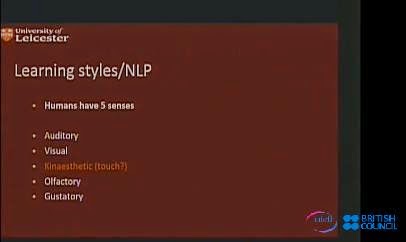
As an example, Russell mentioned the '5 senses' mentioned by NLP/learning styles enthusiasts (see slide left), although "in actual fact human beings have many other senses, such as the sense of pain, sense of temperature and a sense of time and sense of taste.
Brain Gym also boasts that it helps us use more of our brains than we normally use, promoting the myth that human beings normally use only 10% of our brains, debunked by cognitive scientists, but still believed by many people.
Q: Does it make claims that are vague or hard to test?
Pseudo-scientific claims are often deliberately vague and hard to measure (improve creativity, raise student self-esteem, etc).
Q: Does it use a lot of confusing "sciency" sounding terms?
Learning styles and their instruments (convergers, divergers) is an example. The very name of Neuro-Linguistic Programming is "particularly interesting" as "it has nothing to do with neuro-science, nothing to do with linguistics and nothing to do with computer programming." It also uses a number of sciency-sounding terms.
Q: Does it have little or no scientific credibility?
Russell illustrated this with a number of citations from academic researchers stating that learning styles had "no credible evidence", etc. NLP has also been continually attacked, and yet continues to be popular in some circles. Multiple Intelligences has been criticised by many people too. The most interesting of these is Howard Gardner (who invented the theory). He is not happy with how the theory has been adopted in teaching and has said:
"In one video after another I saw youngsters crawling across the floor, with the superimposed legend ‘Bodily-Kinesthetic Intelligence’. I said, ‘That is not bodily-kinesthetic intelligence, that is kids crawling across the floor. And I feel like crawling up the wall." (Gardner, 199:142)
Q: Is contrary evidence ignored by supporters?
An example Russell gives is from the ELT Journal (Hatami 2013:2), which basically stated "there is no evidence that these work, but we feel good when we use them, so let's use them anyway." Jeremy Harmer is also quoted saying that although there is no evidence that NLP or multiple intelligences work, "they both address self-evident truths" so we should use them anyway (Harmer, 2007:93).
But, Teaching is an art!
In response to this, Russell quoted Michael Swan, who in 2000 complained about an article encouraging teachers to use crystals in the classroom:
"Assertions - in both science and art - always need justification: you don't make things true just by saying they are"
Further Reading
- Buch, P (2014) Neuromyths and why they persist in the classroom
- Coffield et al (2004) Learning Styles and Pedagogy in Post-16 Learning, Learning & Skills Research Centre
- Geake, J (2008) 'Neuromythologies in Education', Educational Research Vol 50 Issue 2
- Hadfield, J (2006) Teacher Education and Trainee Learning Style, RELC Journal
- Howard-Jones, P (2014), Neuroscience and Education, University of Bristol
- Mayne, R (2013) Why we need evidence - Part 1 'It works!'
- Mayne, R (2013) NLP in ELT
- Mayne (2013) The Importance of Research
- Mayne, R (2014) Tales of the undead, ELTJam
- Stahl, S (1999) Different Strokes for Different Folks: a critique of learning styles
- Wilson (2012) The Emperor's New Clothes: Learning Styles and Multiple Intelligences, Education Matters (Vol 2 Issue 8)
Controlled Studies
(updated 19/4/2014 to include other references and the controlled studies, suggested by Russell)
- Devilly, GJ (2005) Power therapies and possible threats to the science of psychology and psychiatry
- Pashler, McDaniel, Rohrer & Bjork (2008) Learning styles: concepts and evidence
- Sense about Science (2008) Braingym
(updated 19/4/2014 to include other references and the controlled studies, suggested by Russell)


